


One of the first things I had to unlearn when I began working with weavers in Guatemala was the idea that I could simply ask for a textile in whatever size I needed. As an interior designer, I am used to thinking in yards, widths, repeats, and dimensions. If I need a larger piece, I specify a larger piece.
A backstrap loom has other ideas. The width of the cloth is connected to the body of the person weaving it. The artisan uses her arms, hips, and back to create the tension that powers the loom, which means most panels can only be woven to about 20 inches wide. Even the floor loom has limits. We can go wider, but eventually we reach a practical ceiling of roughly 35 inches.
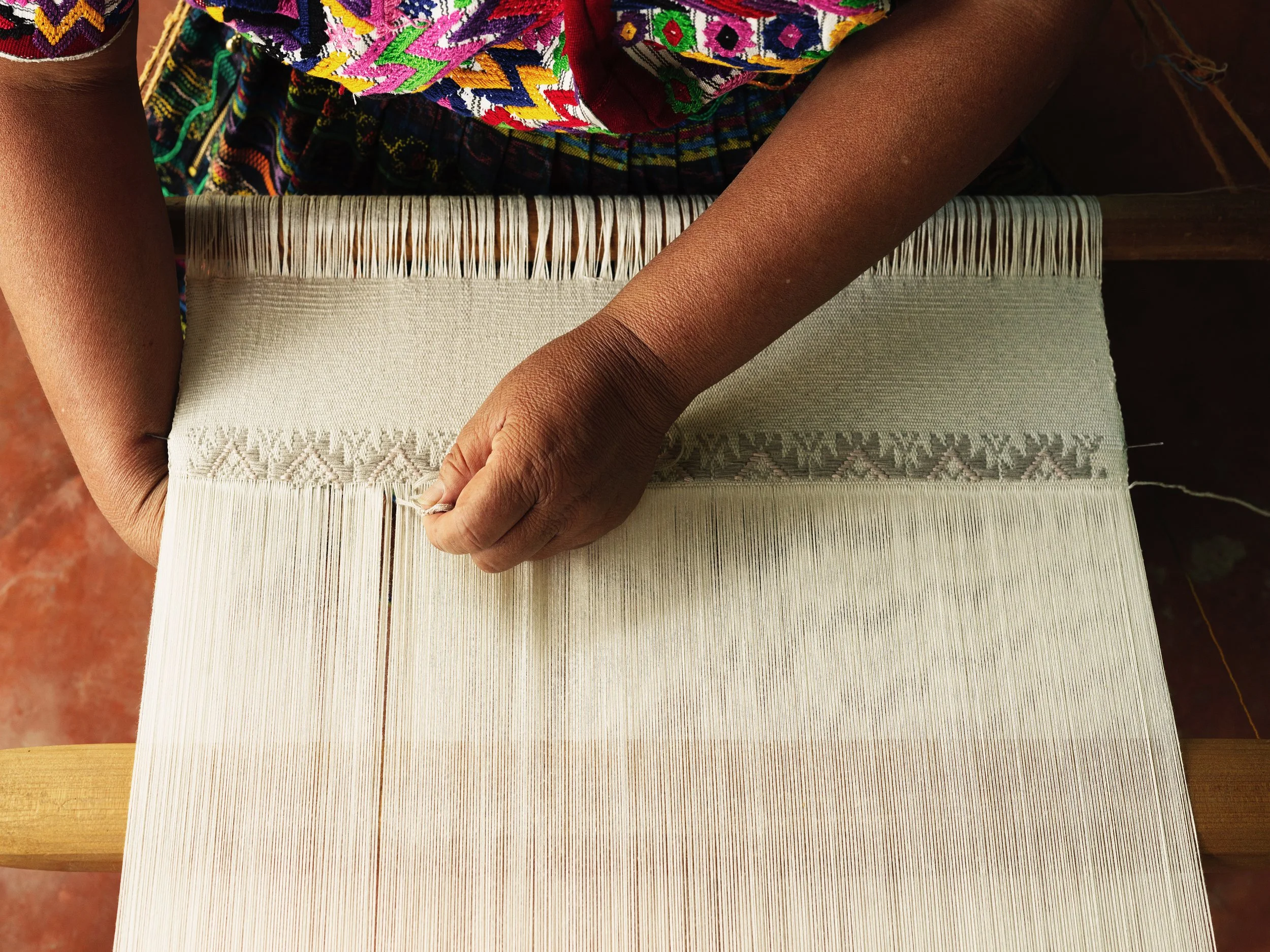
Those dimensions never felt like a problem to solve; they felt like an opportunity to add another layer of design. If the loom could not give us a king sham, throw, or bedding panel in one continuous width, then the question became how the joining itself could become part of what made the piece special. That opened up possibilities I would not have explored with conventionally produced fabric, allowing seams to become details, separate panels to create rhythm, and hand stitching, crochet, and careful alignment to become visible evidence of how the textile was made. Instead of designing around the limitations of the loom, we began designing with them.
What Irma Saw That I Didn’t
The Muñeca Standard Sham is made from three separate handwoven panels. That construction began as a necessity because the backstrap loom simply could not produce the width we needed in a single piece. Once Irma began joining the panels, however, the seam stopped feeling like something we needed to disguise and became part of the design itself.
Each panel is its own textile, and bringing them together requires careful alignment of pattern, proportion, and construction. The Muñeca motif, named after Guatemala’s familiar worry dolls, sits alongside a diamond motif drawn from traditional Nahualá huipiles. The finished sham carries several layers of knowledge within one piece: the limits of the loom, the precision of the weaving, and Irma’s judgment in bringing the separate panels together.
That is one of the things I have come to appreciate most about working this way. A machine could have given us the width immediately, but we would have lost everything that happened because it could not.


This standard sham is expertly crafted in Nahuala from three individually handwoven panels—each one a one-of-a-kind textile, seamlessly joined by Irma. Because of the width limitations of traditional looms, this construction is both a practical necessity and a celebration of technique. The careful alignment of panels, matched with precision and reinforced through meticulous seaming, speaks to the artisan’s mastery and attention to detail.
The design is a thoughtful fusion of tradition and innovation. It features the contemporary Muñeca pattern—named after Guatemala’s beloved Muñeca Quita Penas, or worry dolls, which are given to lighten emotional burdens and offer peace. This motif brings symbolic comfort and storytelling to the piece. Alongside it is a classic diamond pattern inspired by traditional huipiles from Nahuala. In Maya textile heritage, the diamond symbolizes the four cardinal directions, representing balance, guidance, and harmony with the natural world.
Together, these motifs bridge generations of craft and meaning. Through the merging of symbols, motifs, and techniques, this design is completely unique—an heirloom-quality piece that cannot be replicated. It’s a powerful blend of heritage and modern design, made with extraordinary care and intention.
PRODUCTION TIME: 25 Hours
The Textile Lidia Had Kept in Her Archive
The Ladrillo Throw Pillow began with something I found while looking through textiles at Lidia’s weaving studio. The structure was unlike anything I had been seeing elsewhere. Blocks of woven color were separated by small open spaces, and I loved it immediately.
Then I started thinking like an interior designer again. If we turned it into a pillow, the lining would show through those openings. Closing them conventionally would take away the very thing that had made the textile interesting in the first place, so I left Guatemala still thinking about how to solve it.
Later, while walking down Madison Avenue, I saw an Alexander McQueen dress constructed with visible stitching that felt almost architectural. That was the connection. I brought the idea back to Irma, and instead of hiding the spaces between the woven blocks, she began hand-tacking them together. Each stitch is placed by hand, with much of the balance determined by her own eye.
The stitching solved the practical problem, but it also became the detail I now love most. The name Ladrillo means brick, and the stitches quite literally appear to hold the blocks together. The pillow would not exist in this form without Lidia’s archive, a walk down Madison Avenue, and Irma’s ability to understand what I was trying to do and then make it better.
That is much closer to how RB Curated actually develops than sitting at a desk and drawing a collection from scratch.


Tucked away in a home textile archive—our favorite treasure trove—this intricate weaving technique was a hidden gem waiting to be rediscovered. The spark came unexpectedly: a striking Alexander McQueen dress spotted by Regan on Madison Avenue. Its structure and detail reminded us of this traditional craftsmanship and inspired a new vision—where threads, not seams, could hold the design together with intention and artistry.
After the fabric is expertly handwoven, it is transformed once more through hand-stitched detailing between each color block—stitches that symbolically "hold the bricks together," echoing both the construction of a garment and the foundations of a community. Named Ladrillo—Spanish for "brick"—this pillow reimagines something solid and structural into something soft and expressive. It speaks to the essence of Maya weaving: translating the physical world into texture, pattern, and color, while infusing everyday objects with beauty and meaning.
Each hand stitch is placed with extraordinary care by Lidia, finding harmony between vibrant blocks with an intuitive sense of balance. The weavers don’t work within strict direction or mapped-out designs—just inspiration. Their innate understanding of color and composition guides the process, resulting in a piece that feels both spontaneous and deeply rooted.
With its rich palette and graphic detail, Ladrillo is a warm, versatile piece—an homage to Guatemalan streets, resilience, and the creative power of reinterpretation.
PRODUCTION TIME: 37 Hours
“The stitching solved the practical problem, but it also became the detail I now love most. ”
What Alirio’s Loom Could Give Us
The Óvalo Throw Blanket brought us back to the same question in a different way. Alirio and his team weave the textile using the falsería technique, but even on the floor loom, the available width was not enough for the throw I had in mind.
So again, we stopped trying to make the textile behave like something industrially produced and designed around the loom instead. The throw is woven in narrower panels, and Irma then joins those panels with crochet and finishes the outside with a hand-stitched blanket edge.
We could have used a machine seam simply to close the gap, but the hand-executed joinery became part of what makes the piece compelling. You can see where one person’s work ends and another person’s begins. Rather than hiding the construction, the finished throw makes that collaboration visible.


Handwoven by Alirio and his team on a footloom using the rare falsería technique, this throw is a true expression of master craftsmanship. Once widespread in Guatemala, falsería is now practiced by only a few highly skilled artisans capable of executing its complex patterns. This particular design requires the precise coordination of 50 heddles—a level of difficulty that demands deep technical expertise and intimate knowledge of weaving traditions.
The elegant oval motif is especially rare in Guatemalan textiles, where geometric forms typically dominate. Its presence here reflects both innovation and reverence: a bridge between ancestral symbolism and contemporary expression. The flowing curves and balanced rhythm of the pattern echo the refined sensibility of old-world European textiles, reminiscent of some of Regan’s longtime favorite Italian fabric houses—where tradition, sophistication, and artistry converge.
Due to the loom’s width limitations, this piece was woven in narrow panels, each one aligned with great precision. Every seam and finishing detail by Irma —from the custom-designed layout to the hand-executed joinery—was carefully considered to preserve the integrity of the pattern and elevate the final composition.
Finishing touches such as crochet joinery and a hand-stitched blanket edge add strength, refinement, and a quiet softness to the piece. The result is an original, one-of-a-kind textile that honors centuries of craftsmanship while offering a fresh, enduring addition to thoughtful interiors.
PRODUCTION TIME: 110 Hours
See available samples here: SAMPLES

The Part You Don’t See in the Finished Textile
Before spending so much time in Guatemala, I assumed that handmade meant the design happened first and the artisan executed it afterward. That has not been my experience at all.
I may arrive with an idea, a palette, a drawing, or a particular use in mind, but then the textile starts pushing back. The loom has a limit. A pattern behaves differently once it is woven. An artisan sees a solution I did not. A sample comes back and sends us in another direction. An idea I notice in Guatemala may follow me to New York or Paris and then return to Guatemala changed.
That back and forth is the work, and increasingly, it is the part I find most interesting.
Why I Keep Going Back
It would be easier to design textiles without some of these constraints. They could be wider, faster, more uniform, and easier to reproduce exactly. But they would also be different.
Working this closely with the people making the textiles has changed how I think about what makes an object worth living with. Sometimes it is the irregularity. Sometimes it is the seam. Sometimes it is knowing why a design had to change. And sometimes it is simply knowing that another person’s judgment is visible in the finished piece.
The things I bring home from Guatemala are not only textiles. They are ideas about how things can be made differently.



